Showing posts with label articles for parents. Show all posts

Tuesday, 26 September 2017

First Day of School


The first day of kindergarten is right at the door and it's time for your child to begin an educational journey that will last nearly two decades. How can you make this day smooth sailing?

Crying - First of all, be prepared for a bit of crying! It's normal! children screaming and holding on to their parents' necks or legs as if their lives depend on it is a very common scenario on the first few days at Kindergarten. Many times, they won't even want to look at the classroom or the teacher, let alone going inside alone. Don't panic! 

Take a deep breath and keep a calm voice.. don't show your child that you are feeling guilty or even worse -  please don't cry yourself! -- You can do that later :) it's ok - we've all done that.

Kids love routine, so kindergarten at a new school, with a new teacher and new friends is a very big change - so it's ok if they panic a little bit.

Some other children might be so used to going to nurseries and child care, that their first experience in kindergarten will be completely relaxed and easy going and they will probably sit down and start playing with the table toys prepared by the teacher.

Whatever your child's behaviour- keep a big smile on your face and BE POSITIVE.

For some children, the crying doesn’t start until they see other kids doing it. Sometimes they get scared or irritated with all the other children crying and all the noise they make in the classroom.

Don't worry, the teacher will have a very good technique to settle everybody down. In most cases, she will encourage you to leave. It will probably be the hardest thing you’ll have to do, but it really does work. Most of the time, the child stops crying within five minutes of the parent leaving.

You’ll return to school at 12:00 to find your child, happy and content. If the preschool teacher can’t get your child to calm down, she will phone you. Trust in her experience and know she has your child’s best interest at heart.

Saying goodbye to your child is going to be very hard, especially if he or she is crying, but PLEASE it is very important that if the child wants to go back out of the classroom -

DO NOT TAKE THEM OUT- It will make it much harder to bring them back in.

DO NOT CARRY YOUR CHILD TO THE CLASSROOM - if you walk holding your child's hand, first of all they will feel important and grown up as they are going to class and secondly, it is much easier for the teacher to let them in the classroom, then having to pull them off your neck if they cry and latch on.

DO NOT PROMISE THAT YOU WILL BE WAITING AT SCHOOL -  OUT THE DOOR OR IN THE CORRIDOR ETC. - it will make your children tempted to run out of the class at any chance they get! - please tell them that you will go shopping or cooking etc. and you will be back to pick them up soon.

If your child does well on the first day, be prepared, the crying might happen out of nowhere, a few weeks into the school year, this is very common too. Basically the excitement of school being something new would have worn off and your child realizes that she or he isn’t with you. Keep bringing them to school and dropping them off as this too shall pass.

I wish you all an amazing experience at our school!

Best regards,

Miss Ben.

Tuesday, 11 October 2016

Sensory Play and Early Child Development

In our classroom we are going to have many different sensory bins. Some are seasonal, such as the Christmas bin and Halloween bin, whilst others will be there all year round, such as the sand bin, compost bin, rice bin, water bin and beans bin.


Sensory play includes any activity that stimulates your young child’s senses: touch, smell, taste, sight and hearing. Sensory activities and sensory tables facilitate exploration and naturally encourage children to use scientific processes while they play, create, investigate and explore. Spending time stimulating their senses helps children develop cognitively, linguistically, socially and emotionally, physically and creatively.

Wednesday, 2 March 2016

Article for parents

Teaching correct pencil grip. Help your child learn to hold a pencil correctly.

This article is about pencil grip - nevertheless I would like you to try this with your children by using a crayon - only when they have mastered crayon grip, try it out by using the pencil; as the pencil is much thinner and more difficult to hold properly - Miss Ben :)

To teach the correct way to hold a pencil, you can have the child pretend his/her dominant (writing) hand is an alligator.  Open and close the alligator’s mouth – and show that the alligator is hungry and wants to eat the pencil!

Place the pencil on the bottom jaw of the alligator,and close the alligator’s mouth on the pencil.
  How to teach a child to hold a pencil correctly
Proper way to hold a pencil
Now that the alligator is holding the pencil, watch what he does with the pencil!  
As the alligator eats the pencil, he doesn’t like the taste of the pencil, so he puckers his lips.  (Show your children what it means to pucker your lips!)
Correct way to hold a pencil
He puckers his lips and curls his jaws in the shape of an ‘o’ – and clenches the pencil in his teeth.
How to hold a pencil correctly: The alligator trick
If your child continues to struggle, there are some neat tools out there that really help children to grip a pencil correctly.  Click the picture below to see the tool we recommend for teaching someone how to hold a pencil correctly.   We do not recommend the small grips that slip onto a pencil – in my experience, they still confuse the child where and how to hold the pencil.  These sort of pencil grips may help your child feel more comfortable holding a pencil (ergonomically correcting an already correct grip).
How to properly hold a pencil

Friday, 16 October 2015

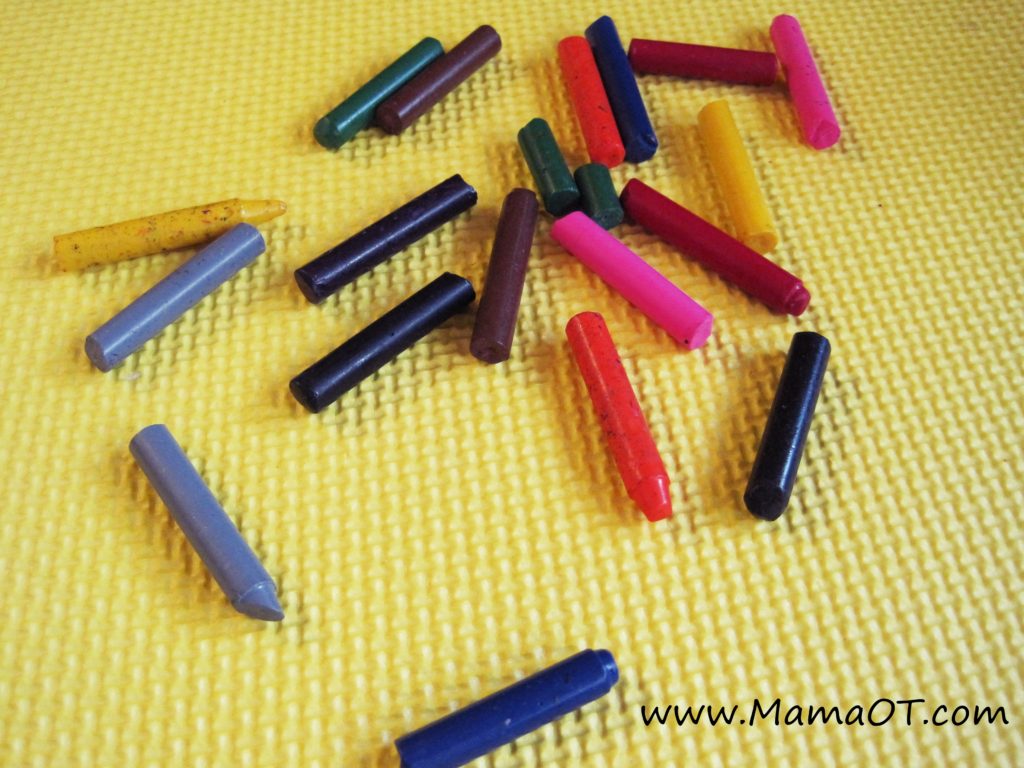
Don’t throw out your broken crayons: Use short crayons to promote correct grasp!


good visual to aid understanding of the writing process and fine motor development. - Re-pinned by #PediaStaff.  Visit http://ht.ly/63sNt for all our pediatric therapy pins:


“No! Don’t break that…(crack!)…crayon.”
Sound familiar?
I know, you hate it when kids break stuff. It means toys have been ruined and money wasted.
But, thank goodness, it’s not true when it comes to crayons! They are actually better when they’re broken.
Here’s why.
Kids develop the ability to grasp and use a writing utensil in a fairly predictable progression.
  • 1 to 1/2 years old: Kids use a “cylindrical grasp”, also called a “fisted grasp”.It looks just like it sounds — they hold the crayon with their entire fist, pinky side down toward the paper.
  • 2 to 3 years old: Kids still use all 5 fingers but they change their hand position so their index finger is pointing down toward the tip of the crayon. This is referred to as a “digital grasp” or “digital pronate” (because of the pronated position of the forearm) and marks a significant transition in grasping and fine motor abilities!
  • 3 1/2 to 4 years old: Kids begin to hold the crayon with increased dexterity as they transition to holding the crayon with only 4 fingers in a “modified tripod grasp”. This grasp mimics the mature tripod grasp but incorporates additional fingers. Most kids this age have a “static” grasp. This means the movements are primarily coming from the shoulder while the wrist and fingers remain in one position and move together as a unit. This is why kids this age do best with large coloring surfaces and are not yet able to truly color within the lines.
  • 4 1/2 to 7 years old: Kids transition into holding the pencil with a more efficient and mature “tripod grasp”. This means they pinch the pencil with the thumb and index finger while resting it on the knuckle of the middle finger. Ideally, the pencil is laying back on the web space of the hand (that fleshy part between the thumb and index finger). A variation of the tripod that is also considered efficient and mature is the “quadrupod grasp”, which is essentially a tripod grasp but with an extra finger pinching the pencil (thumb, index, and middle finger pinch the pencil while resting it on the knuckle of the ring finger). Kids this age transition into using a “dynamic” grasp as they are now able to move the pencil with their finger and wrist movements rather than initiating movement from the shoulder, which allows for increased precision and control while writing, coloring, and drawing.
Sometimes, however, preschool-aged kids will get “stuck” in the fisted or digital pronate grasp and have a hard time transitioning into a more mature grasp.
The solution?
Give them a crayon that’s been broken in half.
This naturally encourages them to “pinch” the crayon between their thumb and index finger, moving them into a more mature and skilled grasp pattern. The reason is simple — it’s hard to use a cylindrical or digital pronate grasp on a short crayon.
Don’t believe me? Try it for yourself.
I actually encourage parents and teachers of young kids to break crayons in half in order to promote more mature grasp patterns as they develop their fine motor skills (be sure to remove the paper, though). And, as an added bonus, it gives you twice as many crayons so there are more to go around!
So the next time you feel the urge to go out and buy more crayons because the ones you have at home are broken, think again! Those broken, washed up crayons are just waiting to be used to help your little ones with the development of their fine motor skills.

http://mamaot.com/dont-throw-out-your-broken-crayons/

Thursday, 15 October 2015

Magical, powerful playdough!


With playdough we do a lot of fun things! - Squishing, rolling, sculpting, molding . . . young children love to play with playdough. Add somefun things from around the home and playdough play becomes a powerful way to support your child’s learning. 

This simple tool lets children use their imaginations and strengthen the small muscles in their fingers—the same muscles they will need and use to hold a pencil and write.

 Using playdough with you, a friend, or siblings supports your child’s social skills such as sharing, taking turns, and enjoying being with other people. Playdough also encourages children’s language and literacy, science, and math skills—all at the same time! 

More information at :http://families.naeyc.org/learning-and-development/music-math-more/playdough-power


Wednesday, 11 December 2013

Avoiding dinnertime battles with our children

How can parents avoid the dinnertime battle with their children?

Comment on this
Still, there are some gentle ways parents can nudge their kids toward more healthful eating habits. Here are a few thoughts from nationally knownnutrition experts on how to get kids to go from being picky eaters to people with sound, varied diets:
  • Avoid a mealtime power struggle. One of the surest ways to win the battle but lose the war is to engage in a power struggle with your child over food, says Jody Johnston Pawel, LSW, CFLE, author of The Parent's Toolshop. With power struggles, you're saying, "Do it because I'm the parent" and that's a rationale that won't work for long, she says. But if your child understands the why behind the rules, those values can lay the groundwork for a lifetime of sound food choices.
  • Let kids participate. Get a stepstool and ask your kids to lend a hand with easy tasks in the kitchen, says Sal Severe, PhD, author of How to Behave So Your Children Will, Too. "If they participate in helping to make the meal, they are more likely to want to try it," he says. Older children and teens can begin to prepare special meals or dishes by themselves. Get teens started learning to prepare healthy foods before it's time to live on their own.
  • Don't label. Severe reminds parents that, more often than not, kids under 5 are going to be selective eaters. "Being selective is actually normal," says Elizabeth Ward, MS, RD. She prefers the term "limited eater" to the more negative term "picky."
  • Build on the positives. "When I sit down with parents, we'll often find that their child actually does eat two or three things from each food group," says Ward. Just as children can get comfort from reading the same story over and over, they enjoy having a set of "predictable" foods. "Even though they aren't getting a wide variety of foods, they are actually doing OK nutritionally," says Ward. When the child goes through a growth spurt and has a bigger appetite, use that opportunity to introduce new foods, she recommends.
  • Expose, expose, expose. Ward says a child needs to be exposed to a new food 10 to 15 times before he or she will accept it. But many parents give up long before that. So, even if your child only plays with the strawberry on her plate, don't give up. One day, she just may surprise you by taking a bite. But don't go overboard, says Severe. Limit exposure to one or two new foods a week.
  • Don't bribe. Avoid using sweets as a bribe to get kids to eat something else, says Pawel. That can send the message that doing the right thing should involve an external reward as well as reinforces the pattern that eating unhealthy foods is a good way to reward yourself . The real reward of sound nutrition is a healthy body, not a chocolate cupcake.
  • Beware of oversnacking. Sometimes the problem isn't that the child doesn't like new foods but that they are already full, says Ward. "Kids can consume a lot of their calories as milk and juice." Encourage the kids to drink water rather than juice when they're thirsty. You can also create flavored waters by adding a splash of their favorite juice to sparkling or still water. The same goes for snacks that provide little more than calories, such as chips, sweets, and sodas. "If you are going to offer snacks, make sure they are supplementing meals, not sabotaging them," she says.
  • Establish limits. Having a set of bottom-line limits can help a parent provide some consistency, says Pawel. For example, parents may require that kids eat nutritious foods before snack food. Or that they must at least try a new food before rejecting it. "Consistency only works if what you are doing in the first place is reasonable," she says. So, avoid overly controlling or overly permissive eating rules. If bottom-line limits are healthy, effective, and balanced, they'll pay off.
  • Examine your role model. Make sure you aren't asking kids to "do as I say, not as I do," says Pawel. If your own diet is based mainly on fat, sugar, and salt, you can hardly expect your child to embrace a dinner salad over French fries.
  • Defuse mealtimes. Don't make your child's eating habits part of the mealtime discussion, says Ward. Otherwise every meal becomes a stressful event, centered on what the child does and does not eat. Ward suggests that parents reserve talks about the importance of good eating for later, perhaps at bedtime or story time.
  • Give it time. "I find that children become much more open to trying new foods after the age of 5," says Ward. "Most of the time, kids will simply grow out of limited eating."
Medically Reviewed by a Doctor on 1/30/2012


Tuesday, 8 October 2013

Language development

Teaching Your Child to Talk…There’s No App for That

5 ways to build early language skills (and set up kids for future success!)
You might be surprised how simple it is to support language development…..and set the stage for even more advantages in the future!
Years ago, researchers Betty Hart, PhD and Todd Risley, PhD of the University of Kansas, uncovered some amazing results from a very in-depth study of young children (0-3), their caregivers, and their conversations.  After three years of observing 42 families from across a varied socio-economic pool, and examining the more than 1,300 hours of interactions they had recorded, they discovered a great deal about language, but also made some surprising connections along the way.
They were already aware of one well-known finding:  There’s an academic divide across the socio-economic landscape that shows kids from more affluent homes succeeding in schools and kids from poorer homes struggling.  But the next thing they uncovered was more surprising.  The connection to academic success may not come directly from income, rather from something that is absolutely free.  Words.
The researchers found that children in affluent homes heard more words per day than the children from lower SES brackets.  Children from families on welfare were exposed to just over 600 words in an hour of interactions.  Children from working-class homes were exposed to over 1,200 words in that same amount of time.  Topping them all, however, were the children from professional class families, who heard over 2,100 words in an average hour.  Over the course of the first three years of life, that’s a difference of millions of words. 
Now here’s the best part.  Hart and Risley asserted that families from the lower SES brackets who talked like the families in the higher SES brackets had children who performed in school like those higher SES kids.  It was the accumulation of conversations that increased their learning abilities, not the accumulation of wealth.
Considering the seriousness of the educational disparity along socio-economic lines, it’s almost shocking to think that that disparity could be lessened or even erased with something so simple, so accessible as WORDS.

WORDS: How many?  What Kind?

According to Hart and Risley, the optimal input of words in a young child’s day totals around 30,000 words.  That seems like a lot.  But it can come from a lot of sources.  Reading and discussing books at story time could easily yield 2,000 words.  Talking during diaper changes and meal times could increase that total exponentially.  But there is one source of verbal input that was NOT shown to add to those totals:  TV. While there are plenty of words coming from the screen, those words didn’t carry the same benefits as words shared in a conversation with an adult (or even older children) with whom the child shared a relationship.
As Dr. Khanh-Van Le-Bucklin, M.D., an academic pediatrician with the University of California, Irvine has been quoted“I tell parents that the best toy they can give their children is themselves.  No educational toy, TV program or video can positively affect a child’s development like time spent with an engaged and talking adult.”
While examining hours and hours of conversations, Hart and Risley also looked at the types of conversations that were taking place.  They found that the caregivers who ended up tallying lower numbers of words per day were most often speaking to the child in directives.  “Put on your coat.“  “Get in the car.”  “Go eat your dinner.”  But those who hit the ideal 30,000 word mark were those who engaged the child in conversation and narrated their experiences through the day with descriptive language.
Consider this alternative to the low-yield directive, “Put on your coat.“:
It’s time to go see Grammy!  But first we need to get your coat on.  It’s so cold and windy today.  Can you see those trees?  See their branches moving?  It’s so windy!  Brrr!  Let’s get your coat!   Let’s put one arm in…..there’s your hand!  Now the other arm……there’s your hand!  Now we need to ziiiiiiip it up!  Do you want your hood on or off?  On?  There you go!  You looks so warm now!  I should put on my jacket too……”
A four word directive turns into an 80+ word experience!  It’s easy to see how quickly the disparity between directive caregivers and conversational caregivers can grow.  According to the research it can be the difference of 8 million words a year!
Can you imagine if we were talking about calories?  If we were discussing the difference between kids who got the necessary 30,000 “calories” a day vs the kids were were only getting 5,000?  In that context we can see that there are children who are absolutely starving for words!
I firmly believe that parents want what’s best for their kids.  I don’t think there’s anyone out there who is intentionally withholding words in the hopes of stunting their child’s development.  There are many things that may lead a parent to talk more or less to their children.  Work schedules, stress, illness, and childcare options can be big roadblocks, and we don’t always have full control over them.
But I also believe there are simpler roadblocks, like awareness, that we can try to remove.  Today.  We can start today by being aware of the distractions that are stealing precious conversations (TV, phones, rushed schedules) while at the same time becoming more aware of the many opportunities for conversations in the everyday moments of our lives.

Here are 5 Ways to Build Early Language Skills:

  • Recognize Cues…and Respond! - Even infants and preverbal toddlers participate in the give-and-take “dance” of conversation.  If you don’t think so, check out this video or this one.  Learn to recognize when children are making attempts to communicate.  Making eye-contact, cooing, even hand tapping can be attempts to engage you.  Respond by talking or by mirroring the child’s attempts.  The simple act of taking turns cuing and responding lays the first foundation for conversation.
  • Become a Sportscaster - Give a verbal play-by-play to describe what’s going on in your child’s daily experiences.  Talk through the steps as you dress your child, prepare a bath, or serve up dinner.  This is great for giving your child meaningful words in their natural context (as you see in this video, the word “water” was learned through interactions in — surprise!– the kitchen and bathroom).  As an added bonus, this technique also keeps little ones engaged during periods where they might otherwise become impatient!
  • Be Present, Be Patient - Perhaps the biggest threat to young children getting enough words each day is the busyness and distraction that engulf us.  On the flip side, the best way to bring words into the lives of our children is to be truly present and aware of what they are paying attention to.  When we give them the words in the moments that hold the most meaning for them, the impact is powerful.  But we have to slow down, be aware, and take the time to talk at a comfortable, natural pace.
  • Remember to Pause -  With all this focus on exposing kids to enough words each day, it’s easy to get caught up and overload kids with words.  But quiet is important too.  We have to give kids a chance to contribute as well — whether verbally or nonverbally.  Without remembering to pause, we’re only talking AT children, not WITH them, and we sadly miss the mark.  (Read more about this technique from a fabulous post about the Perfect Pause from The Little Stories.)
  • Collect Drops in a Bucket - Remember that children accumulate their verbal abilities one word at a time.  It’s like adding drops of water to a bucket.  Each one seems small and insignificant, but as they accumulate over time, soon you find they’re overflowing!  As we see from the research, simple differences on a daily or even hourly basis may not seem like much in the moment, but over the course of a childhood, it adds up to a difference of millions of words.  And with those words, a world of opportunity opens up.

Article about - Sensory play

A Handful of Fun: Why Sensory Play is Important for Preschoolers

(Please, please, feel free to print and share this article with parents and teachers! Simply cite the source as Amanda Morgan, www.notjustcute.com.)
 Think of your average preschooler.  How long has this child been proficient with language?  Depending on the age, the child may not really be too proficient yet!  Others seem to have been talking non-stop since 2 1/2, but that means they’ve been talking now for all of…..about a year!  Now think of how long these children have been seeing, smelling, hearing, feeling, and tasting.  Their whole lives!  Children are wired to receive and utilize sensory input from day one.  This is why children will dive in hands first, exploring a new substance.  The senses are their most familiar, most basic way to explore, process, and come to understand new information.
This is why we must allow young children to learn through experience, not just lecture.  These children need to use their senses and be engaged in meaningful experiences.  As we talk with them about what they are observing and sensing, we give them new language tools to connect with these more familiar sensory tools, building language as well as supporting cognitive concepts specific to the experience. 
Now, the flip side to this equation is important to remember as well.  Just as children learn through their senses, they also are developing the ability to use those senses and are building the neurological pathways associated with each one.  With added sensory experiences, combined with the scaffolding of adults and peers, children become more perceptive.  Their sensory intake and processing becomes more acute.  As they are better able to use their senses, they are then better able to learn through their senses.
Sensory play is really part of the scientific process.  Whether out loud or within the internal dialogue of the mind, children have developed a question, leading them to investigate- by grabbing, smelling, listening, rubbing, staring, licking , what have you!  They are using their senses to collect data and from that, attempt to answer their own questions.  Whether or not young children are always able to verbally communicate this process, it is still a valid exercise in scientific inquiry.
The sensory table is the usually the first place people think of for sensory play.  That’s logical, as the term “sensory” is shared by both.  The sensory table certainly stands as an open invitation for hands-on exploration, but it is not the only place where the senses come into play.  Throughout the preschool room and throughout the preschooler’s day, there are appeals being made to the five senses.  The sound of toppling towers in the block area, the feel of finger-paint sliding under their fingertips, the glow of the Light Brite at the small manip table, the smell of cinnamon playdough.  As teachers, the more we can attend to the sensory involvement of our planned activities, the more our children will be engaged and the more they will learn. 
For example, when discussing the need for warm clothes in the winter time, we can simply tell children about it, or we can have them hold ice cubes, one in a bare hand, and one in a gloved hand, let them really feel the difference and then meaningfully attach a verbal discussion to the sensory experience.
Back at the sensory table, we can find many more benefits to sensory play.  That bin of sand, or foam, orcolorful rice is more than just another way to keep kids busy, it is a bustling factory of developmental growth.  In addition to honing sensory and science skills, sensory play builds languagesocial, and dramatic play skills as the children negotiate with one another to share tools, create stories, and build dialogues.  Both small and large motor skills get a boost as well, as the children manipulate the medium and tools of the day.  Creative, divergent thinking is displayed as the children are essentially invited to explore and come up with new ways to use the materials.  Cognitive skills are fostered as well as the children learn about specific concepts pertinent to the bin’s contents.  Things like gravity, parts of plants, states of matter, and color mixing are easily explored and understood through sensory play.  As you teach appropriate boundaries with sensory play, children develop more self-control and body awareness.
As one of the truest open-ended activities, sensory play provides an opportunity for every child to succeed.  No matter whether you are gifted or delayed, learning a new language or mastering your first, you can’t really fail with a bin full of beans or a ball of playdough.  Children who struggle to succeed or who are apprehensive about failure often find solace in sensory play.  The simple act of pouring water or running fingers through rice is often cathartic and calming to many children who may be struggling emotionally.  It can soothe the nervous child, distract the homesick child, and serve as an outlet for the angry child.  For children with special needs and sensory integration disorders, sensory play may be particularly therapeutic. (Please note that we must also avoid over-stimulation in many sensitive children.  Special attention must also be paid to children with sensory integration disorder and properly recognizing their thresholds.)
We often think of the sensory table as being a tactile activity, which it largely is, but the other senses come into play as well!  The tapping sounds of popcorn kernels hitting the bin, the pungent smell of baking soda and vinegar at work, the sight of separating colors as tinted water, oil, and syrup are mixed together are all sensory experiences that can be tapped at the sensory table.  Taste sometimes finds less desirable ways to sneak in at the table as well, though taste-tests can also be properly planned as fantastic sensory experiences!
Find ways to optimize sensory play for your children.  Whether that’s providing a bin of sand to explore, giving your child a dish wand and plastic dishes to “wash” at the sink, or finding ways to integrate the senses into your other activities, provide space and time for sensory play!  It’s a natural and satisfying way to explore and learn!