
Thursday, 22 October 2015

Friday, 16 October 2015
Don’t throw out your broken crayons: Use short crayons to promote correct grasp!

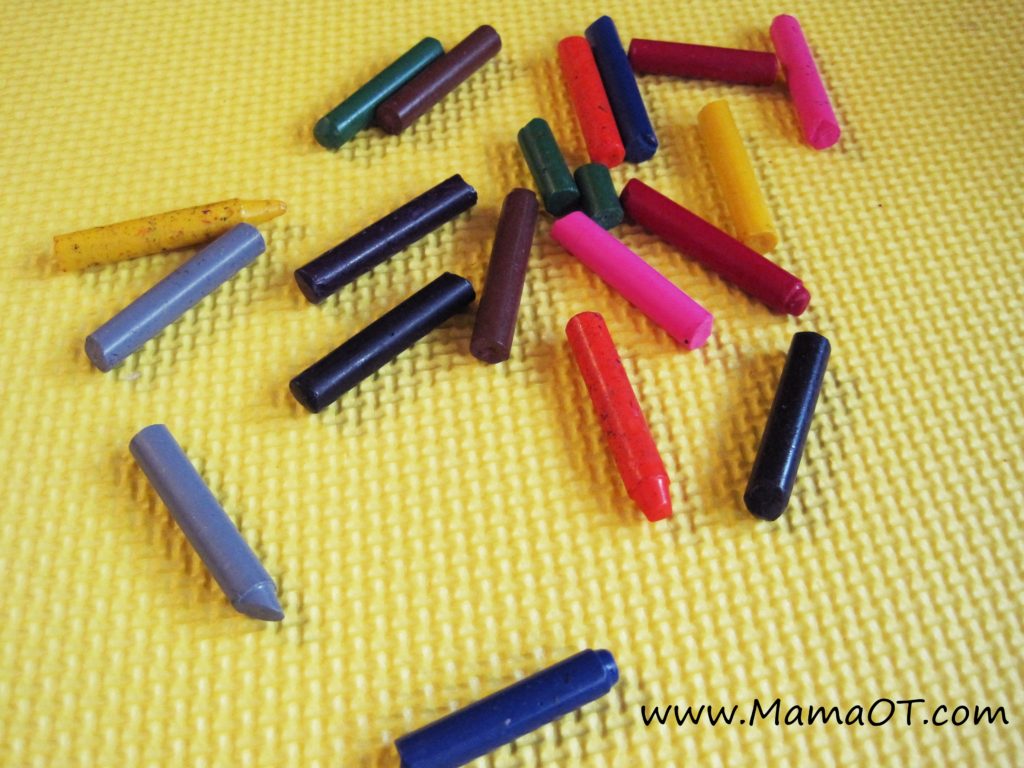 “No! Don’t break that…(crack!)…crayon.”
Sound familiar?
I know, you hate it when kids break stuff. It means toys have been ruined and money wasted.
But, thank goodness, it’s not true when it comes to crayons! They are actually better when they’re broken.
Here’s why.
Kids develop the ability to grasp and use a writing utensil in a fairly predictable progression.
- 1 to 1/2 years old: Kids use a “cylindrical grasp”, also called a “fisted grasp”.It looks just like it sounds — they hold the crayon with their entire fist, pinky side down toward the paper.
- 2 to 3 years old: Kids still use all 5 fingers but they change their hand position so their index finger is pointing down toward the tip of the crayon. This is referred to as a “digital grasp” or “digital pronate” (because of the pronated position of the forearm) and marks a significant transition in grasping and fine motor abilities!
- 3 1/2 to 4 years old: Kids begin to hold the crayon with increased dexterity as they transition to holding the crayon with only 4 fingers in a “modified tripod grasp”. This grasp mimics the mature tripod grasp but incorporates additional fingers. Most kids this age have a “static” grasp. This means the movements are primarily coming from the shoulder while the wrist and fingers remain in one position and move together as a unit. This is why kids this age do best with large coloring surfaces and are not yet able to truly color within the lines.
- 4 1/2 to 7 years old: Kids transition into holding the pencil with a more efficient and mature “tripod grasp”. This means they pinch the pencil with the thumb and index finger while resting it on the knuckle of the middle finger. Ideally, the pencil is laying back on the web space of the hand (that fleshy part between the thumb and index finger). A variation of the tripod that is also considered efficient and mature is the “quadrupod grasp”, which is essentially a tripod grasp but with an extra finger pinching the pencil (thumb, index, and middle finger pinch the pencil while resting it on the knuckle of the ring finger). Kids this age transition into using a “dynamic” grasp as they are now able to move the pencil with their finger and wrist movements rather than initiating movement from the shoulder, which allows for increased precision and control while writing, coloring, and drawing.
Sometimes, however, preschool-aged kids will get “stuck” in the fisted or digital pronate grasp and have a hard time transitioning into a more mature grasp.
The solution?
Give them a crayon that’s been broken in half.
This naturally encourages them to “pinch” the crayon between their thumb and index finger, moving them into a more mature and skilled grasp pattern. The reason is simple — it’s hard to use a cylindrical or digital pronate grasp on a short crayon.
Don’t believe me? Try it for yourself.
I actually encourage parents and teachers of young kids to break crayons in half in order to promote more mature grasp patterns as they develop their fine motor skills (be sure to remove the paper, though). And, as an added bonus, it gives you twice as many crayons so there are more to go around!
So the next time you feel the urge to go out and buy more crayons because the ones you have at home are broken, think again! Those broken, washed up crayons are just waiting to be used to help your little ones with the development of their fine motor skills.

Thursday, 15 October 2015
Magical, powerful playdough!

With playdough we do a lot of fun things! - Squishing, rolling, sculpting, molding . . . young children love to play with playdough. Add somefun things from around the home and playdough play becomes a powerful way to support your child’s learning.
This simple tool lets children use their imaginations and strengthen the small muscles in their fingers—the same muscles they will need and use to hold a pencil and write.
Using playdough with you, a friend, or siblings supports your child’s social skills such as sharing, taking turns, and enjoying being with other people. Playdough also encourages children’s language and literacy, science, and math skills—all at the same time!
More information at :http://families.naeyc.org/learning-and-development/music-math-more/playdough-power


Wednesday, 14 October 2015
Tuesday, 13 October 2015
Elmo 1234 - Number 1 - Elmo 123 count with me, Sesame Street Elmo count ...
At school we have just started learning about the number 1! Do you like the number 1? Let's jump 1! We have one nose and one mouth! We love the number 1!!
Subscribe to:
Posts (Atom)